


80% of college students study more than high school students but still score lower on exams. This shows that just studying more doesn’t always lead to better learning.
College requires new, active learning strategies. Unlike high school, college has bigger classes, more reading, and important tests. Simple methods like rereading and highlighting don’t help much.
Studies from UNC Chapel Hill and others show that being active in learning is key. This includes making connections, coming up with examples, and checking your understanding. These are the core of good study habits.
The Study Cycle is a helpful tool. It includes previewing, attending, reviewing, studying, and checking. Skipping any step, like previewing, can hurt your learning.
This article shares tips backed by science. You’ll learn about spacing out your study sessions, using short, focused times, and active learning methods. It also talks about how sleep and diet help you remember things better.
Learning to organize your study time means planning daily active sessions. It’s about taking control of your schedule and using short, focused blocks for each class. Tools like study planners and time blocking can help you create a better study routine and use the best study tips to learn faster.
Understand Your Learning Style
Knowing how you learn can save time and help you focus better. Match your study methods to your strengths. This way, you’ll learn more in less time. Use study organization techniques to fit tasks to your best learning style and see your efficiency soar.
Visual, Auditory, and Kinesthetic Learning
Visual learners do well with diagrams, charts, and maps. Create colorful notes and flowcharts to show idea connections. Plan your study time for when you’re most visual.
Auditory learners benefit from lectures and discussions. Record summaries to listen to while commuting. This makes reading active and strengthens memory.
Kinesthetic learners learn by doing and solving problems. Try sample problems, build models, or conduct experiments. This method is great for technical subjects and applying what you’ve learned.
How to Identify Your Preferred Style
Try different methods for a week. Use concept maps, record summaries, and solve problems. See which method you remember best after 24 and 72 hours.
Find out when and how you learn best. Do you remember better from listening, seeing, or doing? Note your preferences to organize your study time better.
For subjects with lots of content, mix your methods. Use maps for history and practice problems for math. Mix your study tips to create flexible routines that respect your learning style.
Create an Effective Study Environment
Where you study affects how well you learn. Choose spots like a library floor, a quiet coffee shop, or a lounge. Switch places to avoid getting too used to one spot.
Match the study spot to the task. Quiet places are best for deep reading. For longer tasks, a bit of background noise helps.
Choose the Right Location
Find the best study spots before you need them. Look at noise levels, comfort, outlets, and Wi-Fi. Libraries are great for reading, while coffee shops are better for writing.
Reserve a spot for specific tasks. This helps your brain get ready for the task.
Minimize Distractions
Turn off distractions and hide your phone. Use apps to block distracting sites. Focus on one task at a time to keep your mind sharp.
Set short rewards for staying focused. Use breaks to check messages. This keeps your main work uninterrupted. Studies show multitasking hurts learning, so focus is key.
Organize Your Study Space
Organize your stuff by topic. Keep notes, slides, and assignments in order. A calendar above your desk helps you remember deadlines.
Start weekly rituals. Fill out a study planner, estimate task times, and leave space for surprises. This helps avoid cramming and keeps your schedule on track.
Have a portable study kit with essentials. This kit helps you stay productive no matter where you are.
| Focus Area | Action | Benefit |
|---|---|---|
| Location choice | Rotate library, café, and lounge based on task | Freshness of environment boosts concentration |
| Distraction control | Silence notifications, use site blockers, single-task | Improved retention and faster task completion |
| Material organization | Label folders by syllabus subtopics and keep a visible calendar | Less time searching; clearer study plan |
| Weekly planning | Use a study planner template and estimate task time | Better prioritization and optimizing study schedule |
| On-the-go kit | Pens, highlighters, flashcards, chargers in a pouch | Immediate productivity when locations change |
Use Active Learning Techniques
Active learning helps you understand and remember better. It involves making connections, creating examples, and checking your own progress. Unlike passive methods like re-reading, these techniques boost your memory and understanding.
Engage with the Material
Make study guides by topic. Write down questions and answers clearly. Use concept maps to show how ideas are connected.
Develop symbols or shorthand for common concepts. This makes it easier to review your notes quickly. Try using flashcards and space reviews to practice recalling information.
For technical subjects, solve problems and explain each step. This turns passive review into active practice.
Teach What You’ve Learned
Explain ideas as if you were the teacher. Record your lessons or lead a study group. Teaching helps you find knowledge gaps and improves your memory.
Make quick quizzes from your study guide. Test yourself often and focus on missed items first. This method fits into short daily study sessions.
Follow the Study Cycle: preview, attend, review, study actively, and check your understanding. Plan 15–45 minute sessions for self-testing and teaching. This supports your study planning and helps you stay on track.
Employ Time Management Strategies
Good time management helps you control your study days better. It reduces stress, improves focus, and balances school and life. Use effective methods to avoid cramming and make steady progress on big projects.
Start by planning your week. Choose a day to list tasks by course and estimate their time. Match these estimates to your available hours. If you run out of time, prioritize readings or split tasks into smaller blocks.
Use Google Calendar, Outlook, Fantastical, or a paper planner like Moleskine or Plum Paper. Pick what helps you stick to your plan.
The Pomodoro Technique
The Pomodoro Technique involves 25-minute focused work sprints followed by 5-minute breaks. After four sprints, take a 15–30 minute break. This method keeps you focused and prevents burnout on long assignments.
Track your sessions with an app like Toggl Track or your phone’s timer. Use Pomodoro within larger calendar blocks to protect your deep work time. This way, you can mix short focus bursts with bigger time blocks for major tasks.
Prioritizing Your Tasks
Prioritizing turns a long list into a clear plan. Try the Eisenhower Decision Matrix to sort tasks into Do First, Schedule, Delegate, and Eliminate. Use “Eat That Frog” to tackle the hardest task early when you’re most energetic.
Time blocking sets aside specific hours for tasks and includes buffers for surprises. Schedule study, breaks, and review periods. Treat these blocks on your calendar like you would a class or lab session.
Mix different systems to fit your workflow. Use Getting Things Done (GTD) to capture ideas and clarify next steps. Apply RPM to keep tasks aligned with purpose. Use the Pareto Principle to focus on the most impactful tasks.
| Method | Best Use | Tools |
|---|---|---|
| The Pomodoro Technique | Short, focused study sessions for retention and stamina | Toggl Track, phone timers, simple kitchen timers |
| Time Blocking | Protecting deep work windows and coordinating classes | Google Calendar, Outlook, Fantastical, paper planners |
| Eisenhower Matrix | Quick task triage when overloaded | Notebooks, note apps, simple four-quadrant templates |
| GTD (Getting Things Done) | Managing many small tasks across courses | Todoist, Microsoft To Do, pen-and-paper inbox |
| RPM | Keeping study linked to clear outcomes and motivation | Notebooks, digital notes, planning templates |
Practical tip: each week, estimate time per class and create a study timetable. Use this schedule to optimize your study time and adjust as deadlines near. Small, consistent changes will keep your time management effective and sustainable.
Utilize Technology to Enhance Learning
Technology can make your study sessions more focused and efficient. Choose the right tools to help you. Use apps that track time, organize tasks, and store notes. This way, you spend less time searching and more time learning.
Start simple. Use Toggl Track to see where your minutes go. Pair it with a study planner template in Notion or Todoist. These tools help you organize your study time without guessing.
Test-drive apps that match your workflow. Use Notion for notes, schedules, and task lists. Use Evernote for quick ideas and reminders. Use Todoist for task hierarchies and calendar sync. Each app supports a different study habit; try a few before you commit.
For active recall, use Quizlet or Anki flashcards with spaced repetition. For deep explanations, visit Khan Academy or enroll in a Coursera course. Use Trello or Asana for multi-step group projects. Keep Google Calendar or Outlook synced for deadline alerts and reminders.
Manage distractions by limiting unnecessary computer use during focused sessions. If a device is not needed, put it away. Use site-blocking apps when concentration slips, following guidance from reliable campus resources like the University of North Carolina at Chapel Hill.
Organize materials into topic folders on your device or in labeled notebooks. This speeds up retrieval when you plan and when you decide how to organize study time. Set daily reminders and calendar alerts for micro-tasks to build steady habits.
Keep a mobile study kit on your phone: flashcards, short notes, and quick schedules. This turns spare minutes into productive ones and reinforces study tips everywhere you go. Evaluate multiple apps; no single solution works for everyone, so choose the mix that fits your routine.
Educational Apps and Tools
- Toggl Track: time tracking and Pomodoro support.
- Todoist: task lists, subtasks, and calendar sync.
- Notion: all-in-one workspace for notes and schedules.
- Evernote: quick note capture and reminders.
Online Resources for Study Aids
- Google Calendar or Outlook for scheduling deadlines and reminders.
- Quizlet or Anki for spaced repetition flashcards.
- Khan Academy and Coursera for supplementary explanations.
- Trello or Asana for managing group projects with clear steps.
Take Regular Breaks to Stay Sharp
Short breaks refresh your mind and keep your focus sharp. They prevent mental fatigue and help you remember better. Studying in short sessions over several days boosts long-term learning and reduces procrastination.
The Benefits of Short Study Breaks
Short breaks after focused work improve your concentration. A 25–45 minute study session followed by a 5–15 minute break reduces burnout. It also boosts your ability to recall information.
Breaks let your brain process what you’ve learned. Moving, drinking water, or doing a mindfulness exercise for two minutes can reset your focus. But avoid long social media sessions unless they’re a timed reward.
How to Schedule Your Breaks
Make breaks a regular part of your schedule. Use cycles of focused study and short rest, then take a longer 15–30 minute break after several rounds. This approach optimizes your study schedule and keeps you productive all day.
Use idle moments for studying. Carry flashcards or a short quiz app for waiting times. In light weeks, use extra time to get ahead on big projects. In busy weeks, rely on your calendar and include buffer times to avoid being overwhelmed.
See breaks as important as study time. This simple habit helps you stay on track without losing balance.
Practice Effective Note-Taking
Good notes make listening active learning. Use clear labels for each topic. Add timestamps or page refs. Summarize big ideas in your own words.
A steady routine ties note review to your study planner template. This keeps material fresh and prevents cramming.
Techniques for efficient notes
- Organize by syllabus subtopics: keep piles or digital folders per unit so you can find concepts quickly.
- Create study guides with questions and full answers to turn notes into active review tools.
- Annotate practice problems and jot short explanations beside each step to reinforce problem-solving paths.
- Use concept maps, symbols, and structured outlines to show relationships between ideas.
Digital vs. handwritten notes
- Handwriting often boosts memory for conceptual material. Try Cornell-style pages for lecture-heavy classes.
- Digital notes give searchability and easy backups. Apps like Notion and Evernote help you tag, link, and sync content across devices.
- Match the medium to the course: handwritten for deep understanding, digital for large volumes and quick review.
Turn notes into study tools after class. Spend short, daily sessions converting raw notes into flashcards, self-quizzes, or teach-from-note outlines. This habit supports spaced practice and fits cleanly into organization techniques for studying that you can follow each week.
Keep backups and indexes. Scan key handwritten pages, store digital exports in the cloud, and number notebooks so you can use a simple index to locate topics fast. Use your study planner template to schedule note consolidation and review sessions.
Regular refinement makes notes work harder for you. Edit unclear sentences, add example problems, and remove redundancy. When notes are tidy, you save time during study sessions and learn more with less stress.
Test Yourself Often
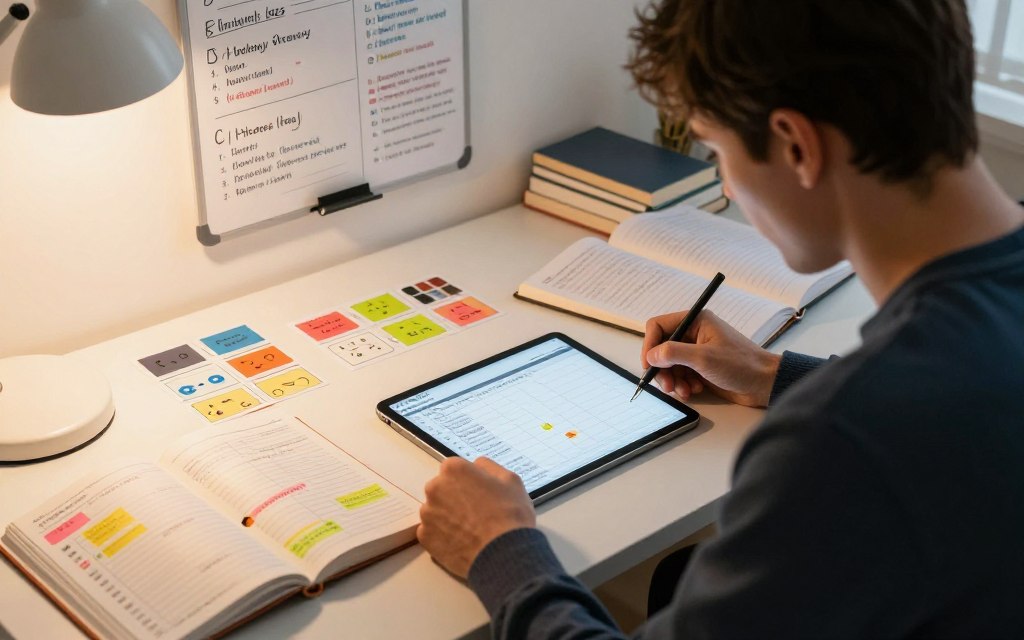
Self-testing makes studying active, not passive. Short quizzes strengthen your memory by making you recall information. This method shows where you need to focus your studying.
The Benefits of Self-Assessment
Testing yourself builds stronger memory paths than just reading notes. It boosts long-term memory and cuts down on relearning time. Regular self-testing also points out areas that need more work.
It also helps you think like your teacher. By practicing with different question types, you learn what’s most important. This helps you plan your study schedule better and get ready for exams.
Tips for Creating Effective Quizzes
Make quizzes from key points in lectures and important topics in the syllabus. Mix up the types of questions, like multiple choice and short answers. Set a time limit to make it feel like a real test.
Use flashcards for names, dates, and formulas. For technical subjects, solve practice problems and explain each step. After checking your answers, spend time on mistakes to reinforce what you learned.
Combine old and new material for better retention. Focus on key topics identified in your study plan. Keep track of your progress and adjust your study schedule as needed.
Make self-testing a regular part of your study routine. For example, after four focused study sessions, use one for testing yourself. This simple change helps you learn faster and improves your study organization.
Maintain a Healthy Lifestyle for Better Study
To study smarter, take care of your body and mind. Get enough sleep, eat well, and exercise regularly. These habits help your memory and focus stay sharp. Make sure to schedule sleep, meals, and exercise in your planner.
The Role of Sleep, Diet, and Exercise
Stick to a sleep schedule and avoid late nights. Sleep helps solidify what you’ve learned. Eat healthy meals and drink water to stay alert. Short breaks for exercise can also boost your energy.
Stress Management Techniques
Manage stress by setting priorities and saying no to extra tasks. Try simple breathing exercises or quick mindfulness activities to refresh your mind. If you need help, campus resources or an academic coach can guide you.
Always include self-care in your schedule. Align your study times with your energy levels. When you take care of your health, you learn and remember better with less effort.